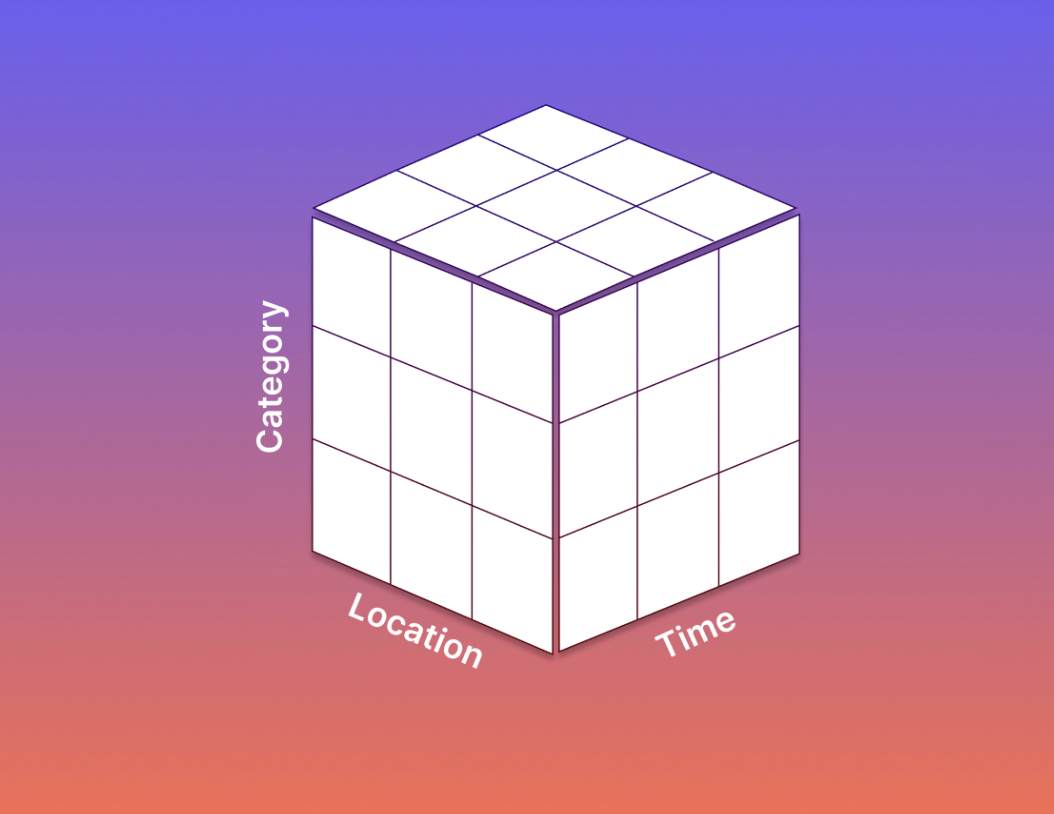
Are cubes dead? Not quite.
Apparently, cubes are “dead” — or at least on their way out.
That was news to me.
Because if you look at how most analytics actually works today, cubes (or cube-like structures) are everywhere.
Every time a dashboard slices a metric by dimensions — channel, cohort, geography — it’s effectively operating on a cube.
Every time an organization aggregates raw data into structured, queryable summaries at scale, it’s building cube-like representations.
So if cubes are dead, they’re doing a remarkably good job of sticking around.
The confusion: concept vs implementation
What’s really happening is simpler:
We’re conflating a concept with its historical implementation.
Yes, older OLAP systems and rigid cube infrastructures have fallen out of favor.
But the idea behind cubes — organizing metrics across dimensions in a structured, queryable way — is still foundational.
In fact, it’s unavoidable.
Any system that needs to answer:
- Revenue by channel
- Retention by cohort
- Conversion by funnel stage
…is implicitly working with a cube.
The implementation evolves.
The abstraction does not.
Modern data stacks are rebuilding cubes — just differently
Take dbt’s metrics layer.
At its core, it defines:
- metrics
- dimensions
- aggregations
- consistent business logic
From there, you can generate “slices” of data across dimensions — i.e., cubes of varying shapes and sizes.
They’re not called cubes.
They’re not materialized the same way.
But conceptually, they serve the same role.
The modern stack hasn’t eliminated cubes.
It has reconstructed them in a more flexible, composable way.
Cubes as a precursor to metric trees
At HelloTrace, we rely heavily on this concept.
Cubes — or more precisely, dimensional metric structures — are a natural precursor to metric trees.
Why?
Because before you can model how metrics relate to each other (a tree), you need to define how each metric behaves across dimensions (a cube).
- Cubes answer: how does this metric vary across slices?
- Metric trees answer: how do these metrics relate and drive each other?
You need both.
The cube provides the dimensional structure.
The tree provides the relational and causal structure.
Together, they form a complete model of the business.
The bottom line
Cubes aren’t dead.
They’ve just shed their old form.
What’s fading is rigid, precomputed infrastructure.
What’s emerging is a more dynamic, model-driven approach to defining and computing metrics across dimensions.
But the core idea — organizing metrics across dimensions to make them analyzable — remains as relevant as ever.
If anything, it’s more important now.
Because as we move toward automated, model-driven analytics, these foundational abstractions matter more — not less.
Cubes are alive and well.
We’re just finally building them the right way.